Controlled Demolition vs Mechanical Breaking: Which One?
When a construction site reaches the demolition or removal phase, the method chosen can affect far more than the concrete itself. It can influence safety, programme timelines, structural risk, access, vibration, dust, noise, waste handling, and the ability of other trades to keep working.
For contractors, civil’s teams, engineers, QS professionals, procurement officers, and project planners, choosing between controlled demolition vs. mechanical breaking is not simply a question of speed. It is a question of method selection.
Both methods are used in concrete demolition and concrete removal, but they are suited to different project conditions. Controlled demolition is typically used where precision, planning, and protection of surrounding structures matter. Mechanical breaking is often used where concrete needs to be broken down and removed efficiently and where impact, vibration, and access conditions can be managed. Both methods are controlled, but the focus of the control is different; for complex structures and removals, mechanical breaking and select controlled demolition methods can work hand in hand, where concrete cutting specific sections aid in the controlled mechanical removal of a structure.
For active and complex sites, the right answer depends on the structure, the environment, the project phase, and the risks involved.
DCCS Coring , Cutting, and Sealing supports contractors and project teams with a method-led approach to concrete work, helping sites move from precision cutting and coring into controlled demolition and concrete breaking with practical planning, reliable equipment, and project-focused execution.
What Is Controlled Demolition?
Controlled demolition is a planned approach to removing concrete or structural elements in a careful, sequenced, and managed way. Instead of simply breaking concrete apart, controlled demolition focuses on removing specific sections while protecting surrounding areas, reducing unnecessary disruption and managing project risk.
This method is often used when demolition work needs to happen in or around active construction sites, existing buildings, sensitive structures, live environments, or spaces where other trades are still working.
Controlled demolition may involve a combination of methods, including cutting, coring, breaking, separation, lifting, removal, and staged dismantling. The goal is to remove what needs to be removed without creating avoidable damage, delays, or safety concerns.
Controlled demolition is commonly used for:
-
Structural alterations
-
Partial concrete removal
-
Renovations and refurbishments
-
Commercial building modifications
-
Civils and infrastructure upgrades
-
Openings in slabs, walls or structural elements
-
Removal near live services or occupied areas
-
Projects where vibration, noise and dust need to be managed
-
Sites where sequencing and safety are critical
For DCCS, controlled demolition fits naturally into its broader concrete capability. The company’s experience in concrete cutting, concrete coring, concrete repairs, and active-site work supports demolition projects where precision and method selection matter.
What Is Mechanical Breaking?
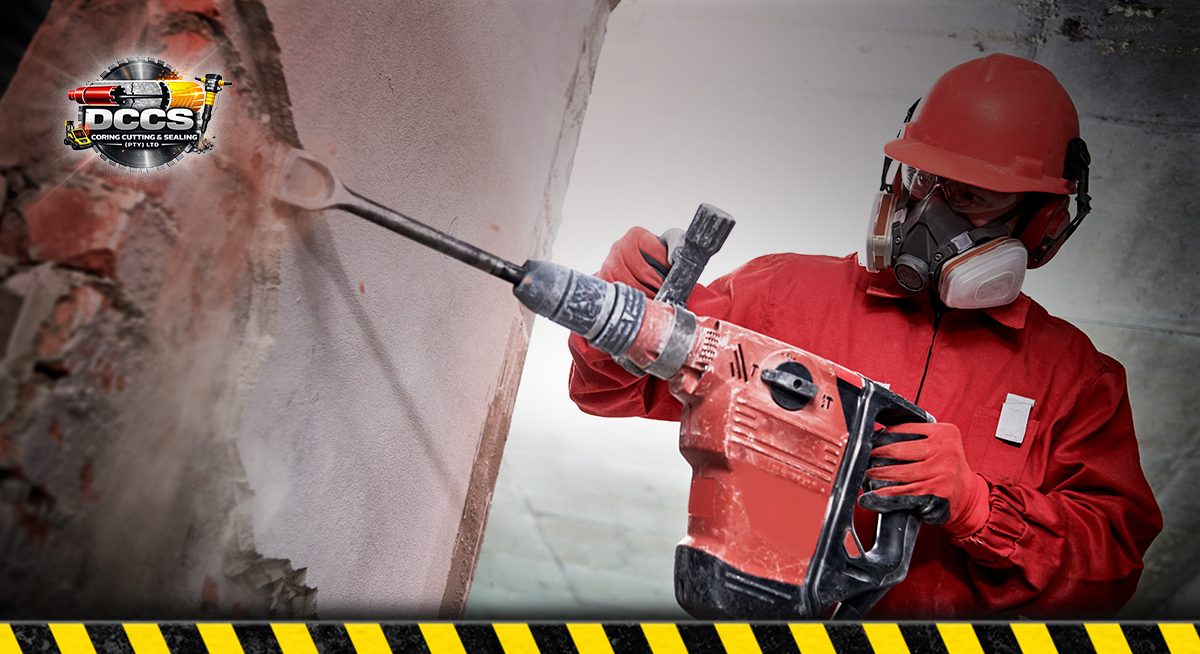
Mechanical breaking is a concrete demolition method that uses impact equipment to break concrete into smaller sections for removal. It is often used when concrete must be broken up efficiently and removed from the site.
This can include slabs, walls, foundations, pavements, hardstanding areas, and other concrete structures where controlled impact is suitable.
Mechanical breaking is commonly used for:
-
Concrete slab removal
-
Breaking down unwanted concrete sections
-
Site preparation
-
Renovations and strip-outs
-
Hard demolition areas
-
Concrete breaking and removal
-
Removal of damaged or redundant concrete
-
Preparing an area for new construction work
Mechanical breaking can be highly effective when the project allows for impact, access is suitable, and the surrounding structure can tolerate the vibration and disruption associated with breaking work.
However, it must still be planned correctly. Poorly managed concrete breaking can create unnecessary mess, programme delays, safety risks, and damage to adjacent structures or services.
A reliable demolition contractor should be able to explain when mechanical breaking is appropriate and when a more controlled approach should be used instead.
Controlled Demolition vs Mechanical Breaking: What Is the Main Difference?
The main difference between controlled demolition vs. mechanical breaking comes down to precision, disruption, and risk management.
Controlled demolition is a planned method used when the demolition process needs to be carefully managed. It is ideal for complex structures, sensitive environments, partial removals, and projects where surrounding areas must be protected.
Mechanical breaking is an impact-based method used to break concrete apart for removal. It is usually suited to areas where speed and removal efficiency are important and where the site can accommodate noise, vibration, rubble, and access requirements.
In simple terms:
Controlled demolition is best when the project needs careful removal.
Mechanical breaking is best when the project needs efficient breaking and removal.
Both methods can be valuable. The skill lies in knowing which one to use and when a combination of methods may be the most practical solution. Often the part that is overlooked when considering demolition is the focus is mainly on the price; mechanical is cheaper because its always just viewed as hiring an excavator or handheld breakers and removing, but when taken in full view, with the removal, the possible damage through vibration to the remaining structure, and the nature of creating safety and precaution in that area, mechanical breaking may end up costing more further down the line and have a "snowball" effect on the program timeline.
When Should You Use Controlled Demolition?
Controlled demolition should be considered when the demolition work requires accuracy, careful sequencing, and reduced risk to surrounding structures or site activity.
Use Controlled Demolition for Active Construction Sites
On active construction sites, demolition rarely happens in isolation. Other trades may be working nearby. Service installations may be ongoing. Program deadlines may already be tight. With controlled demolition, cutting has a unique effect of preventing vibration from traveling through the concrete and affecting areas outside that of the “demolition area.
Controlled demolition allows work to be planned in a way that supports the broader site program. This is important for Tier 1 to 3 construction companies, civil contractors, and commercial builders that cannot afford uncontrolled disruption.
DCCS experience in precision concrete work supports this type of environment, where demolition needs to be integrated into a live construction process.
Use Controlled Demolition for Structural Alterations
If a project involves modifying a slab, wall, beam, column, stairwell, opening, or structural section, controlled demolition is often the safer and more suitable approach.
Structural alterations require care because the work may affect load paths, support conditions, and adjacent elements. In these scenarios, engineers and contractors need confidence that the demolition contractor understands method selection and site constraints.
Controlled demolition helps reduce the risk of damaging areas that must remain intact. Vibration - causes cracking and movement in the remaining concrete out of the area.
Use Controlled Demolition Near Sensitive Areas
Controlled demolition is useful where work takes place near occupied buildings, commercial operations, live services, public areas, hospitals, retail environments, offices, or infrastructure assets.
In these spaces, demolition must be managed around people, access, safety, and continuity of operations.
A controlled approach can help reduce unnecessary vibration, dust, noise, and disruption, especially when combined with concrete cutting, core drilling, or careful sectioning.
Use Controlled Demolition When Accuracy Matters
If only a specific portion of concrete must be removed, controlled demolition is often preferred. This may include openings, edges, structural sections, service areas, or parts of a slab that must be separated before removal.
DCCS's wider capability in precision cutting and coring supports these requirements, especially when demolition work needs to be clean, accurate, and coordinated with other project activity. can include concrete repair; from an objective standpoint, we understand what is affected by what we do and have the knowledge to repair or prevent that damage.
When Should You Use Mechanical Breaking?
Mechanical breaking is suitable when the concrete needs to be broken down for removal, and the site conditions allow for an impact-based method.
Use Mechanical Breaking for Concrete Removal
If the main objective is to remove a section of concrete efficiently, mechanical breaking may be the right method. This applies to slabs, pavements, foundations, redundant concrete sections, and hardstanding areas.
Mechanical breaking is often used in site preparation, strip-outs, and renovation work where concrete must be removed before the next project phase can begin.
Use Mechanical Breaking Where Impact Is Acceptable
Mechanical breaking creates impact, vibration, noise, dust—silica particles in the area—and rubble. That does not make it unsuitable, but it does mean the site must be assessed properly.
It may be a practical method when the surrounding structure is not sensitive, there are no critical services nearby, access is suitable, and the work area can be isolated safely.
Use Mechanical Breaking for Larger Break-Out Areas
For larger areas of concrete that do not require fine separation or surgical precision, mechanical breaking can be efficient. The method allows teams to break concrete into manageable sections that can then be removed from site, with the correct measures put in place, e.g. dust control, crash deck, etc.
The key is to ensure the correct equipment is used and that breaking is planned around access, safety, and waste handling.
Use Mechanical Breaking as Part of a Combined Method
Mechanical breaking does not always stand alone. In many projects, concrete cutting may first be used to separate an area, reduce the risk of overbreak, or create a clean edge. Mechanical breaking can then be used to remove the section.
This is where a multi-capability contractor like DCCS can add value. The team can support cutting, coring, concrete breaking, and controlled removal as part of one project-led approach.
How Site Conditions Influence the Right Demolition Method
Choosing the correct demolition method depends on the site conditions. Before selecting controlled demolition or mechanical breaking, contractors and project teams should assess the following factors.
Access to the Work Area
Restricted access can influence equipment selection, sequencing, and removal methods. Tight spaces, upper floors, basements, live buildings, security-controlled sites, and busy construction environments all require planning.
A demolition contractor should understand how equipment will reach the work area, how rubble will be removed, and how the work will affect site movement.
Structural Sensitivity
Some structures can tolerate mechanical breaking. Others require a more controlled method. Reinforced concrete, load-bearing elements, adjacent structures, and existing finishes may all influence the decision.
If there is any risk of damaging what must remain, controlled demolition should be considered.
Nearby Services
Electrical conduits, plumbing, drainage, post-tension cables, and other embedded services can affect demolition planning. Where services may be present, scanning, cutting, or careful opening may be required before breaking or removal begins.
This is especially important in renovation and strip-out environments where existing services may not be fully visible.
Noise, Dust and Vibration
Mechanical breaking can generate more vibration and noise than controlled demolition methods. In live or sensitive environments, this can affect tenants, staff, the public, machinery, neighboring properties, and other trades.
Controlled demolition can help reduce disruption when the project requires a more measured approach.
Programme Pressure
July often brings ongoing builds, renovations, strip-outs and preparation for next project phases. In these situations, demolition work can sit directly on the critical path.
The right method can help keep the programme moving. The wrong method can delay follow-on trades, create extra clean-up, or require remedial work.
DCCS’s value lies in supporting time-pressured teams with practical method selection, precision work and reliable execution.
Why Safety and Planning Matter in Concrete Demolition
Concrete demolition carries risk when it is not planned properly. The work may involve heavy materials, reinforced concrete, structural elements, restricted access, falling debris, vibration, slurry, dust, rubble, and nearby trades.
This is why planning is essential.
A professional demolition contractor should consider the following:
-
The demolition scope
-
The structure and surrounding elements
-
Access and equipment requirements
-
The correct demolition method
-
Safety procedures
-
Waste handling and concrete removal
-
Dust and noise control
-
Embedded services
-
Work sequencing
-
The impact on follow-on trades
-
Communication with site teams
For engineers, project managers, and QS teams, this planning helps reduce uncertainty. It also supports better costing, a clearer scope, and fewer surprises once work begins.
DCCS's unique selling point is not only its ability to perform concrete work. It is the ability to support project teams with a practical, method-led approach that helps reduce rework, minimise delays and keep complex sites moving.
Can Concrete Cutting Support Controlled Demolition?
Yes. Concrete cutting can play an important role in controlled demolition.
Before concrete is removed, cutting can be used to create separation lines, define removal sections, protect surrounding structures, and reduce uncontrolled breaking. This helps make demolition more accurate and manageable.
Concrete cutting can support demolition by:
-
Creating clean edges before removal
-
Separating sections for controlled break-out
-
Reducing overbreak
-
Preparing openings
-
Supporting staged removal
-
Improving accuracy around sensitive areas
-
Helping protect surrounding concrete
Core drilling can also support demolition where circular openings, access points, lifting points, service penetrations, or relief points are required.
This is one of the reasons DCCS is well positioned for active and complex sites. The team can support projects where concrete cutting, core drilling, controlled demolition, mechanical breaking and concrete removal overlap.
How DCCS Approaches Demolition Method Selection
DCCS understands that construction teams are not looking for demolition in isolation. They are looking for a reliable subcontractor that can help solve site challenges quickly, safely and accurately.
The audience for controlled demolition and mechanical breaking usually includes:
-
Contractors and construction firms that need reliable subcontractors
-
Civils and infrastructure contractors working on complex sites
-
Commercial builders managing tight timelines
-
Project managers and site managers coordinating multiple trades
-
QS and procurement teams evaluating cost, scope and supplier suitability
-
Engineers and consultants influencing method selection
-
Project planners preparing the next phase of work
For these teams, the right method must support the project outcome.
DCCS brings value through:
Practical Method Advice
The team can help determine whether controlled demolition, mechanical breaking, concrete cutting, core drilling, or a combined approach is most suitable for the project.
Precision and Reliability
DCCS background in precision concrete cutting and coring strengthens its demolition capability, especially where accuracy, clean edges, and reduced disruption are important.
Support for Active Sites
DCCS works with the realities of active construction environments, including access restrictions, tight deadlines, safety requirements, and coordination with other trades.
Equipment Readiness
DCCS operational strength includes equipment capability, in-house manufactured core barrels and blades, stock availability, and practical backup support. This helps reduce avoidable delays when work is time-sensitive.
Proven Contractor Experience
DCCS has operated since the early 90s and has worked as a subcontractor to major contractors on recognised South African developments. This gives project teams confidence in the company’s ability to support demanding construction environments.
Controlled Demolition vs Mechanical Breaking: Which Method Is Right for Your Project?
The right method depends on what the project needs to achieve.
Controlled demolition may be the right option if:
-
The site is active or sensitive
-
Surrounding structures must be protected
-
The demolition is partial or structural
-
Noise, dust and vibration need to be managed
-
Accuracy and sequencing are important
-
The work is near services or occupied areas
-
Engineers require a method-led approach
Mechanical breaking may be the right option if:
-
Concrete needs to be broken down for removal
-
The work area can tolerate impact
-
Access is suitable for breaking equipment
-
The surrounding structure is not highly sensitive
-
The project requires efficient breakout
-
Rubble handling and waste removal are planned
-
The concrete removal area is clearly defined
In many cases, both methods may be used together. A section can be cut first, then mechanically broken and removed. Core drilling may be used for access or service points. Controlled demolition may guide the sequence, while mechanical breaking handles the removal.
The best method is the one that protects the project program, reduces unnecessary risk and delivers the required result.
Frequently Asked Questions About Controlled Demolition and Mechanical Breaking
Is controlled demolition better than mechanical breaking?
Not always. Controlled demolition is better for sensitive, complex, or active sites where precision and risk management matter. Mechanical breaking is better when concrete needs to be broken and removed efficiently and the site can accommodate impact, vibration, and noise.
When should I use mechanical breaking?
Mechanical breaking is suitable for concrete removal, slab break-outs, site preparation, strip-outs, and areas where impact-based breaking is acceptable.
Can controlled demolition be done on an active construction site?
Yes. Controlled demolition is often used on active construction sites because it can be planned around access, safety, sequencing, and other trades.
Do I need concrete cutting before demolition?
In many projects, concrete cutting can support demolition by creating clean separation lines, reducing overbreak and making removal more controlled.
What information is needed for a demolition quote?
Useful information includes the site location, scope of work, drawings, photos, access details, timeline, concrete thickness, reinforcement details, nearby services and whether the project requires controlled demolition, mechanical breaking, or concrete removal.
Move Your Site Forward With DCCS
Choosing between controlled demolition and mechanical breaking is about more than removing concrete. It is about selecting the method that protects your timeline, your structure, your safety requirements, and your next phase of work.
If your project needs controlled demolition, concrete breaking, concrete demolition, or concrete removal, DCCS can help you choose the right method and keep the site moving with confidence.
Move with DCCS.