
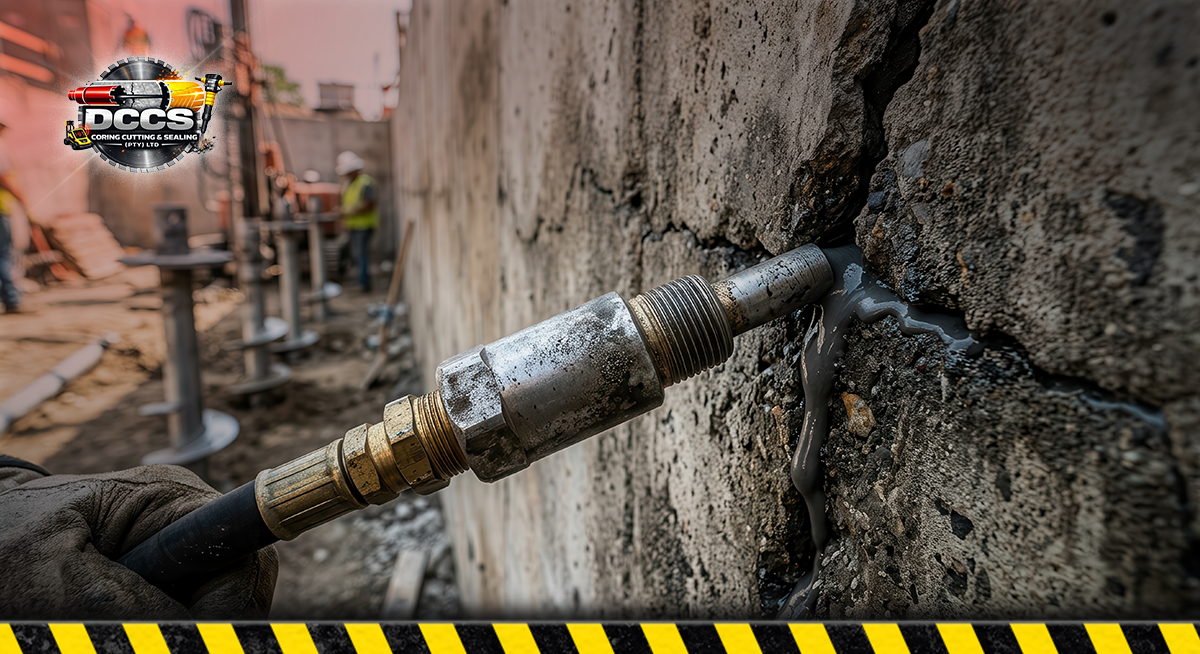
Concrete Repair: Crack Injection vs Replacement
Concrete repair is not always a simple choice between patching a crack and replacing an entire section. On active construction sites, commercial buildings, industrial facilities and managed properties, the correct repair method can affect cost, structural performance, downtime and long-term durability.
For contractors, QS teams, engineers, consultants, property developers, asset owners, facilities managers and maintenance teams, visible cracking is often a warning sign. Sometimes the solution is targeted crack repairs using injection methods. In other cases, the damaged concrete may need to be removed and replaced because the defect is too advanced for injection alone.
Understanding the difference between concrete crack injection and replacement helps project teams make better repair decisions, avoid unnecessary work and reduce the risk of recurring defects.
DCCS Coring supports concrete repair projects with a practical, method-led approach. From crack injection and structural concrete repairs to epoxy concrete repair and specialist concrete remediation, DCCS helps clients choose the right repair method for the structure, site conditions and long-term performance requirements.
Why Choosing the Right Concrete Repair Method Matters
Concrete repair decisions should never be based only on what is visible at surface level. A crack may look minor, but it could be linked to movement, water ingress, shrinkage, reinforcement corrosion, structural stress, poor construction joints, impact damage, or long-term deterioration.
Choosing the wrong repair method can lead to:
-
Recurring cracks
-
Water ingress
-
Spalling concrete
-
Reinforcement corrosion
-
Structural weakness
-
Unnecessary concrete replacement
-
Downtime in operational environments
-
Higher long-term repair costs
-
Delays to follow-on trades
-
Safety concerns
For QS and procurement teams, incorrect repair decisions can create cost uncertainty. For engineers and consultants, they can create technical risk. For property owners and facilities teams, they can result in repeated maintenance and disruption.
This is why DCCS Coring approaches concrete repair through proper method selection. The goal is not only to close a crack, but to understand the defect, recommend the correct repair route and support long-term structural performance.
What Is Concrete Crack Injection?
Concrete crack injection is a targeted concrete repair method used to fill, seal, bond, or stabilise cracks in concrete. It is commonly used when the surrounding concrete is still sound and the defect can be treated without removing and replacing the full section.
Crack injection usually involves introducing a specialised repair material into the crack under controlled conditions. Depending on the project requirements, this may involve epoxy injection, polyurethane injection, or another suitable system.
Epoxy Crack Injection
Epoxy injection is often used where a crack needs structural bonding. The epoxy material fills the crack and can help restore continuity where the surrounding concrete remains stable and suitable for repair.
This type of repair may be considered for structural cracks, slabs, walls, beams, columns, or other concrete elements where strength and bonding are important.
DCCS Coring’s epoxy concrete repair capability supports projects where durability, precision and long-term performance matter.
Polyurethane Crack Injection
Polyurethane injection is often used where water ingress is a concern. It can help seal active leaks, prevent water movement and protect concrete from further moisture-related deterioration.
This may be useful for basements, retaining walls, tanks, wet areas, below-ground structures and other environments where water is entering through cracks or joints.
When Crack Injection Works Best
Crack injection is often suitable when:
-
The crack is localised
-
The surrounding concrete is still sound
-
The crack is accessible
-
Water ingress needs to be controlled
-
Structural bonding is required
-
The defect does not require full concrete removal
-
Downtime needs to be minimised
-
The repair needs to be targeted and efficient
For active buildings and construction projects, crack injection can be a valuable repair option because it may reduce disruption compared to full replacement.
What Is Concrete Replacement?
Concrete replacement involves removing damaged, deteriorated, or failed concrete and reinstating the area with new repair material or concrete. This method is used when the existing concrete is no longer suitable for injection alone.
Replacement may be required when the damage is too severe, too widespread, or when the surrounding material has lost integrity.
Concrete replacement may involve breaking out damaged concrete, preparing the substrate, treating reinforcement if required and reinstating the section using the correct repair material or method.
When Replacement Is Usually Considered
Concrete replacement may be required when:
-
Concrete is badly cracked or crushed
-
Spalling concrete is widespread
-
Reinforcement is exposed or corroded
-
Honeycombing is severe
-
Concrete has delaminated
-
The section has lost structural integrity
-
The defect keeps returning
-
There is deep deterioration
-
The surface cannot support a durable repair
-
The concrete has failed due to impact, overloading, corrosion, or poor material condition
Replacement is often more invasive than crack injection, but it may be the correct decision when the concrete is too damaged to repair locally.
DCCS Coring supports this type of decision-making by helping project teams understand when a targeted repair is enough and when a more extensive structural concrete repair is required.
Concrete Crack Injection vs Replacement: What Is the Main Difference?
The main difference between crack injection and replacement is how the repair deals with the damaged concrete.
Crack injection repairs the crack within the existing concrete. It is used when the surrounding concrete is still stable enough to remain in place.
Replacement removes the damaged concrete and reinstates the area. It is used when the existing concrete is no longer sound enough to support a reliable repair.
In simple terms:
Crack injection treats a crack.
Replacement treats a failed concrete section.
Both methods have value, but they solve different problems. A small structural crack may be better suited to epoxy injection. A leaking crack may need polyurethane injection. A badly spalled section with corroded reinforcement may need concrete removal, steel treatment and reinstatement.
The right fix depends on the cause, severity and condition of the concrete.
When Is Concrete Crack Injection the Right Fix?
Concrete crack injection is often the right fix when the defect is localised and the surrounding concrete remains structurally sound.
Localised Crack Repairs
If the crack is limited to a specific area and there is no evidence of wider deterioration, crack injection may be suitable. This allows the repair to target the defect without unnecessary removal of sound concrete.
For facilities managers and property owners, this can reduce downtime and disruption, especially in operational spaces.
Water Ingress Through Cracks
Where water is entering through a crack, injection may help seal the pathway and reduce further moisture movement. This is important because water ingress can contribute to reinforcement corrosion, spalling concrete and long-term deterioration.
In these cases, the repair material must be chosen according to the water condition and performance requirement.
Structural Cracks Where Concrete Is Still Sound
Some cracks may require structural bonding. If the concrete on both sides of the crack is still sound and stable, epoxy injection may be suitable for restoring continuity.
Engineers and consultants should assess whether the crack is static, whether movement is ongoing and whether injection is technically appropriate.
Repairs Where Minimal Disruption Is Required
Crack injection may be suitable in live environments where full replacement would create unnecessary downtime, noise, dust or access issues.
This can be relevant for:
-
Commercial buildings
-
Industrial sites
-
Parking structures
-
Basements
-
Residential developments
-
Retail environments
-
Infrastructure assets
-
Maintenance areas
DCCS Coring’s practical site experience supports these environments, where speed, precision and reduced disruption matter.
When Is Concrete Replacement the Better Option?
Concrete replacement is usually the better option when the concrete has deteriorated beyond the point of localised injection repair.
Severe Spalling Concrete
Spalling concrete occurs when concrete flakes, breaks away, or loses surface material. It is often linked to moisture ingress, reinforcement corrosion, poor cover, impact, or long-term deterioration.
If spalling is minor and localised, repair may be possible. If spalling is extensive or reinforcement is exposed, replacement or structural repair may be required.
Spalling should not be ignored because it can expose steel reinforcement and allow corrosion to progress.
Exposed or Corroded Reinforcement
When reinforcement begins to corrode, it expands and places pressure on the surrounding concrete. This can cause cracking, delamination and spalling.
In this case, simply injecting the visible crack may not solve the underlying problem. The damaged concrete may need to be removed, the reinforcement treated and the area reinstated.
Severe Honeycombing
Honeycombing refers to voids, rough patches, exposed aggregate, or poorly compacted areas in concrete. It can occur due to poor placement, inadequate vibration, congested reinforcement, or poor mix conditions.
Minor honeycombing may be repaired with suitable repair materials. Severe honeycombing may require removal and reinstatement, especially if it affects structural performance or durability.
Failed or Crushed Concrete Sections
Where concrete has been crushed, weakened, overloaded, impacted, or structurally compromised, crack injection is unlikely to be enough.
Replacement or structural concrete repair may be required to restore performance.
Recurring Cracks or Moving Defects
If a crack keeps returning after previous repairs, the issue may be linked to movement, settlement, vibration, loading, expansion, poor joint design, or structural stress.
Injection may not be suitable unless the cause has been identified and addressed. In some cases, replacement, joint treatment, structural repair, or engineering input may be required.
Key Factors That Influence the Repair Decision
Choosing between crack injection and replacement depends on more than the appearance of the defect. A professional concrete repair decision should consider several technical and practical factors.
Crack Width and Depth
The width and depth of the crack help determine whether injection is possible and what material may be suitable. Fine cracks, deep cracks and wide cracks may require different repair approaches.
Crack Movement
A static crack may be suitable for injection. A moving crack may require a different repair strategy because the movement may cause the repair to fail.
Moisture and Water Ingress
If water is present, the repair method must account for moisture. This may influence whether polyurethane injection, sealing, drainage improvement, or another method is required.
Location of the Defect
A crack in a non-structural floor may be treated differently from a crack in a load-bearing wall, beam, column, water-retaining structure, or basement wall.
Reinforcement Condition
If reinforcement is corroded or exposed, replacement and structural repair may be required. Injecting the crack without dealing with steel corrosion may only hide the problem temporarily.
Site Access
Access affects equipment, preparation, safety and repair time. Difficult access may influence whether a more targeted repair method is preferred.
Operational Downtime
Facilities managers and asset owners often need repairs completed with minimal interruption. Crack injection may reduce downtime in some cases, while replacement may need more planning and sequencing.
Long-Term Performance Requirements
The repair should match the intended use of the structure. Industrial floors, parking decks, structural elements and high-traffic areas may require stronger repair systems than low-risk cosmetic areas.
DCCS Coring’s USP is the ability to approach these factors practically, combining site understanding, method selection and concrete repair capability to recommend the most suitable route.
What Engineers, Property Managers and Contractors Should Check First
Before deciding on crack injection or replacement, project teams should gather enough information to understand the defect.
Check the Cause of the Crack
The cause matters. Cracks can be caused by shrinkage, settlement, movement, overloading, thermal changes, corrosion, poor workmanship, impact, or design-related stress.
A repair that does not address the cause may not last.
Check Whether the Crack Is Active
If the crack is changing, widening, leaking, or recurring, it may be active. Active cracks need careful assessment before injection or replacement is chosen.
Check for Water Ingress
Water ingress can indicate a bigger durability problem. It can also affect material choice and repair sequencing.
Check for Spalling Concrete or Delamination
Spalling and hollow-sounding areas may indicate deeper deterioration. In these cases, the visible crack may only be part of the issue.
Check for Honeycombing or Poor Concrete Quality
Honeycombing may affect durability and structural performance. Its severity should be assessed before repair work begins.
Check Whether Engineer Input Is Required
If the crack is structural, if reinforcement is involved, or if the defect affects load-bearing elements, engineer input may be required.
DCCS Coring supports contractors, engineers and property teams by providing practical repair support for projects where technical understanding and site execution both matter.
How DCCS Approaches Concrete Repair Method Selection
DCCS Coring approaches concrete repair as part of a full lifecycle concrete service. That means the company understands how concrete may need to be cut, drilled, removed, repaired, reinforced, or reinstated depending on the project.
This is especially useful for active sites and managed facilities where multiple concrete services may overlap.
For example:
-
A cracked structure may need concrete scanning before repair.
-
A failed section may require controlled removal before reinstatement.
-
A leaking crack may require injection.
-
A damaged industrial area may need epoxy concrete repair.
-
A structural element may require more detailed repair planning.
-
A repair area may need cutting or coring before the final solution is applied.
DCCS Coring’s strength lies in practical, method-led execution. The team focuses on:
-
Understanding the defect before recommending a fix
-
Matching the repair method to the project requirement
-
Reducing unnecessary removal where targeted repair is suitable
-
Supporting structural and industrial environments
-
Working with contractors, QS teams, engineers and facilities teams
-
Keeping active sites moving with reliable execution
-
Providing clear support for urgent or planned concrete repair work
This approach helps position DCCS as a full lifecycle concrete specialist, from modification and removal to repair and long-term structural performance.
Why Early Concrete Repair Protects Long-Term Performance
Concrete defects often become more expensive when they are left untreated. A crack can allow water to enter. Water can reach reinforcement. Reinforcement corrosion can expand and break surrounding concrete. Spalling concrete can expose more steel. The repair scope can grow from a local crack repair into a larger structural remediation project.
Early concrete repair can help:
-
Reduce water ingress
-
Limit reinforcement corrosion
-
Prevent defects from spreading
-
Reduce safety risks
-
Protect asset value
-
Reduce future downtime
-
Improve durability
-
Support long-term structural performance
-
Avoid unnecessary replacement
For property developers and asset owners, early repair protects investment. For contractors and project managers, it helps reduce delays. For facilities managers, it supports ongoing maintenance and safer operation.
DCCS Coring helps clients act before small concrete defects become bigger project problems.
Need Concrete Crack Repair Support?
Concrete crack injection and replacement both have a place in concrete repair. The right fix depends on the cause of the defect, the condition of the concrete, the presence of water, the reinforcement condition and the long-term performance requirements of the structure.
Choose crack injection when the crack can be treated within sound concrete.
Choose replacement when the concrete section is too damaged, deteriorated, or structurally compromised to repair locally.
Choose DCCS Coring when you need practical guidance, reliable execution and a concrete repair partner that understands active sites, structural requirements and long-term performance.
Build with DCCS.
Contact DCCS Coring today for concrete repair support, crack repairs, structural concrete repairs and epoxy concrete repair solutions.
FAQs About Concrete Crack Injection and Replacement
Is crack injection a permanent concrete repair?
Crack injection can be a long-lasting repair when the crack is suitable for injection, the correct material is used and the cause of the crack has been properly assessed. If the crack is still moving or the underlying cause remains unresolved, further repair may be needed.
When should concrete be replaced instead of repaired?
Concrete should be replaced when the section is severely damaged, deteriorated, crushed, spalled, delaminated, or structurally unsound. Replacement may also be required when reinforcement corrosion has affected the surrounding concrete.
Can crack injection stop water ingress?
Yes, certain injection systems can help stop water ingress through cracks. The correct method depends on the condition of the crack, the amount of water, the structure and the repair objective.
Is epoxy injection suitable for structural cracks?
Epoxy injection may be suitable for some structural cracks where the surrounding concrete is sound and the crack is not actively moving. Engineer input may be required for structural elements.
What causes concrete cracks to return?
Cracks can return when the cause has not been resolved. Common causes include movement, settlement, vibration, overloading, corrosion, thermal movement, poor joint design, or ongoing water ingress.
What is spalling concrete?
Spalling concrete is when concrete flakes, chips, breaks away, or loses surface material. It is often linked to moisture, reinforcement corrosion, poor concrete cover, impact, or long-term deterioration.
What is honeycombing in concrete?
Honeycombing refers to voids, exposed aggregate, or poorly compacted areas in concrete. It can affect appearance, durability and structural performance depending on severity.
Do I need an engineer to assess concrete cracks?
Engineer input is recommended when cracks affect load-bearing elements, structural members, reinforcement, water-retaining structures, foundations, beams, columns, or areas where the cause and severity are unclear.
Can DCCS Coring help with both crack injection and structural concrete repair?
Yes. DCCS Coring supports concrete repair projects including crack injection, structural concrete repairs and epoxy concrete repair, helping project teams choose the correct method for the defect and site conditions.